
The defence minister also announced that India has taken up the challenge of developing a powerful indigenous aero-engine, adding that preparations for this critical project are now almost complete and the work will soon be visible.

'Government officials use Gmail and ordinary phones without basic security consciousness.' 'Interoperability, especially in joint exercises with countries like the US, worries me.' 'It often means we open our systems to them, but they don't reciprocate.' 'They could have kill switches in their systems and might even be able to affect ours.'

'Make-in-India played a key role in India's effective action against terrorism during Operation Sindoor.'

Putin's State visit will centre on fixing the huge India-Russia trade imbalance, with both sides pushing to lower duties, ease non-tariff barriers, and seal a landmark mobility pact to send more Indian workers to Russia.

It said the tests were carried out against high-speed unmanned aerial targets under different interception scenarios.

The jackets have been developed at the DRDO Industry Academia Centre of Excellence at IIT-Delhi, the ministry said in a statement.

India successfully test-fired nuclear-capable short range ballistic missiles Prithvi-II and Agni-I from an integrated test range off the Odisha coast, demonstrating its strategic deterrence capability. The test-firing of the missiles, conducted by the elite Strategic Forces Command, validated all operational and technical parameters.
India fully utilised its military modernisation budget in 2024-2025 -- the first time in five years -- and signed a record Rs 2 trillion defence contracts.

'The first and most basic responsibility of any government is to protect its people from external threats and internal harm.' 'Budget 2025-2026 has to focus on meeting this responsibility,' asserts R Jagannathan.

The Defence Research and Development Organisation is inviting applications from graduates and post-graduates for DRDO internships in the defence and aerospace sectors.

The Indian Air Force is set to retire its fleet of MiG-21 fighter jets at a decommissioning event in Chandigarh. The event will mark the end of an era for the aircraft that has been a key part of the IAF's combat fleet for over six decades.

Prime Minister Narendra Modi is likely to visit the United Kingdom by the end of this month, with the India-UK free trade deal expected to be formally signed. Discussions on expanding bilateral ties in defence and security are also anticipated.
Military officials detail how the Indian Air Force's downing of a Pakistani aircraft at a long distance reflects its air superiority and dealt a psychological blow to the adversary.
The Indian government outlines its futuristic defence programme, Sudarshan Chakra Mission, focusing on indigenous development, predictive technologies, and targeted counter-action systems to enhance national security.
Vice Admiral K Swaminathan highlights concerns over Pakistan's arms procurement and China's growing assertiveness in the Indian Ocean Region.
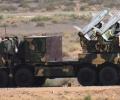
India's indigenously developed 'Akashteer' air defense system performed exceedingly well during 'Operation Sindoor,' according to Defence Research and Development Organisation (DRDO) chief Samir V Kamat. The fully automated system, deployed against terror sites in Pakistan and Pakistan-occupied Kashmir, integrates various radar systems, sensors, and communication technologies. Kamat expressed confidence in the system's success drawing international interest, highlighting India's progress toward self-reliance in the defense sector. He also addressed the future of warfare, emphasizing the need for a blend of traditional and emerging technologies, and outlined the development timeline for the indigenous 5.5-generation stealth fighter aircraft, the Advanced Medium Combat Aircraft (AMCA).
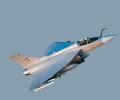
'An HAL-private sector tieup is a possibility.'
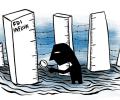
The Centre is regularly holding consultations with stakeholders to streamline foreign direct investments (FDIs) and foreign institutional investments (FIIs) related processes to enable faster and more efficient investment flows into the country, said Commerce and Industry Minister Piyush Goyal, adding one such meeting with stakeholders was held on Tuesday.

Deep-tech now forms over half of VC portfolios in India as firms like Cornerstone, Unicorn India Ventures and All in Capital back startups combining research with scalable models
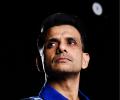
Indian astronaut Shubhanshu Shukla will enjoy a range of Indian dishes, including rice varieties, moong dal halwa, and mango nectar, during his 14-day mission aboard the International Space Station (ISS). He will also have the option to choose from international cuisine, as approved by NASA. ISRO and DRDO have developed the Indian food options for astronauts of the Gaganyaan mission and Shukla will be able to savor them with NASA's approval.
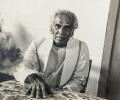
What appeared to be a generous act of friendship was, in truth, a manoeuvre within a much larger strategic game. The United States used the 1962 war not just to aid India but to test how far it could be pulled into the Western fold, points out Dr Kumar.

Currently in its advanced development phase, the team is focusing on refining the robot's ability to understand and execute operator commands.

Defence Ministry spokesperson A Bharat Bhushan Babu said the DRDO never installed any helicopter model in Lucknow.
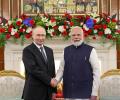
Luckily for us, a Russia that is desperate to stay relevant in an emerging multipolar world finds in India a reliable geostrategic partner. The Russian proximity to India also keeps China from exploiting its economic dominance vis a vis Russia, points out Colonel Anil A Athale (retd).

China calls the shoal Huangyan Dao. China has already deployed some of its biggest CCG vessels in the area to assert its claims.
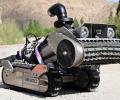
'Our vision is to innovate as many products as we can and solve as many problems as possible.'
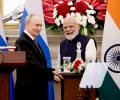
India and Russia have solidified a five-year plan to enhance their economic and trade partnership, while also addressing the ongoing conflict in Ukraine and the threat of terrorism.

Two modules published by the NCERT, Swadeshi: Vocal for Local (for middle stage) and Swadeshi: For a Self-Reliant India (for secondary stage), carry excerpts from the prime minister's Independence Day address in which he stressed that self-reliance would drive India's journey towards a Viksit Bharat.

The Indian armed forces will conduct an exercise to test the capabilities of its drones and counter-drone systems. The exercise, named 'Cold Start', will involve all three services and will take place in Madhya Pradesh.

India's corporate bond market, driven by public sector undertaking (PSU) banks and financial institutions last year, is losing momentum since the second quarter of FY26.

'The natural barrier that is Aravalli, you are demolishing it, then who will stop the desert?' 'In future, I predict that people will roam around with oxygen cylinders in Delhi because they won't be able to breathe.'
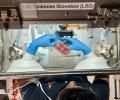
The $1.2 billion in-space manufacturing market is expected to grow and be worth more than $20 billion by 2033.

'10 million Indians are currently living with dementia, and the number is expected to double by 2036.'

The Defence Research and Development Organisation has developed a lightweight bullet-proof jacket that weighs nine kilogram and meets the qualitative requirements of the Indian Army, the defence ministry said on Thursday.
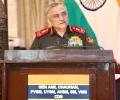
Gen Chauhan said a "whole of the nation" approach will be required to develop the shield.
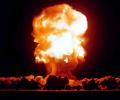
Beijing's latest weapon, 15 times more powerful than TNT, signals a new frontier in high-impact, non-nuclear military technology.
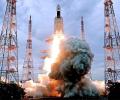
'You can observe a lot of things from space.' 'Another thing is communication, in real time, especially in war-like situations.' 'During Operation Sindoor, we could play our part well.'
Who else will take on the might of Microsoft, Google, and Amazon if not the Adanis, Ambanis, Birlas, or Tatas?, asks R Jagannathan.
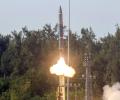
The solid-fuel, battlefield missile developed by Defence Research Development Organisation is based on Prithvi Defence Vehicle from the Indian ballistic missile programme.

With demand for information-technology (IT) services in North America still sluggish, Europe has become a source of optimism for Indian companies because it is delivering steady gains over the past two years and continuing to outperform in the latest quarter. Yet analysts caution a full-scale revival will require a rebound in the United States (US), particularly in manufacturing, retail, and BFSI (banking, financial services, and insurance), because Europe contributes only about a third of the revenues.
 © 2026 Rediff.com - Advertise with us - Disclaimer - Privacy Policy - Sitemap - Feedback - About us - Terms of use - Grievances